


The history of Cat Ba Island is more than a timeline — it is a vivid story of people, the sea, and survival. From prehistoric settlements and the legend of “The Women’s Island” to Hospital Cave and Cannon Fort, each historical layer reveals Cat Ba’s unique identity, inviting travelers not only to admire its landscapes, but to connect deeply with its past.

General Introduction to the History of Cat Ba Island
Overview of the History of Cat Ba Island and Its Historical Geography
The history of Cat Ba Island is always the story I love to share first when beginning a journey with travelers. It is no coincidence that Cat Ba Island is considered the “heart” of the entire archipelago of the same name, belonging to Hai Phong — a place where sea, sky, people, and time quietly converge.
At first glance, visitors can already feel the history of Cat Ba Island through its solemn limestone mountains, crystal-clear bays, and fishing villages nestled gently along the shore. This is not just a beautiful land, but a land rich in memory — one that has witnessed continuous human settlement for thousands of years.
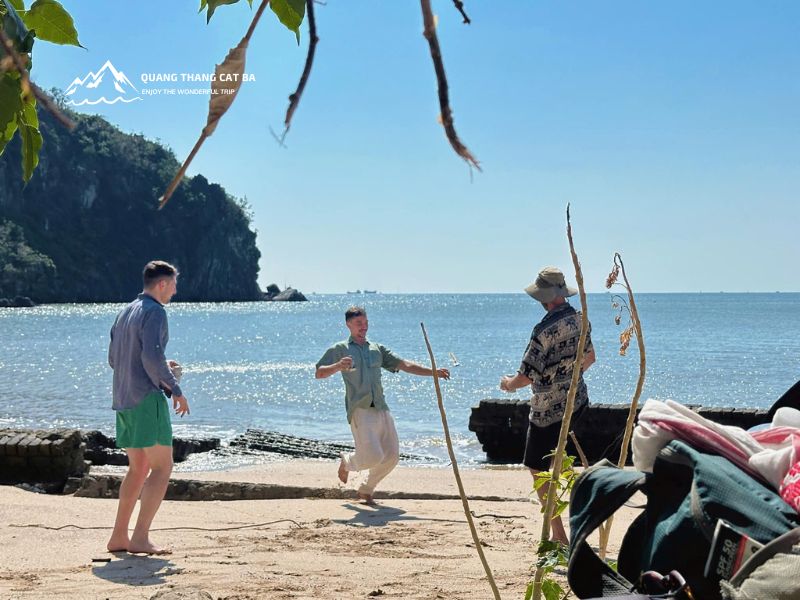
Geographical Location Shaping the History of Cat Ba Island
To help travelers visualize Cat Ba’s importance, I often explain it using a simple table:
|
Factor |
Key Information |
|
Location |
South of Ha Long Bay, adjacent to Lan Ha Bay |
|
Distance |
Approximately 30–60 km from Hai Phong by sea |
|
Scale |
An archipelago of hundreds of islands with diverse terrain |
|
Value |
Ideal for trade, shelter, and coastal defense |
This distinctive location has shaped the history of Cat Ba Island as a vital gateway of the Gulf of Tonkin for centuries.
The Historical Role of Cat Ba Island Through Time
From the perspective of someone who has worked in tourism for many years, I always highlight three major historical roles:
- Prehistoric period: One of the earliest inhabited areas, leaving behind the Cai Beo cultural remains dating back over 6,000 years.
- Feudal era: A strategic stopover, logistical base, and defensive position along the northern maritime routes.
- Later periods: A foundation for long-standing fishing communities and important military constructions.
Looking back, the history of Cat Ba Island cannot be separated from its geography. Its strategic position between major bays has turned Cat Ba into a living witness of Vietnam’s maritime history. And today, when travelers set foot on Cat Ba, they are not only admiring its scenery — they are walking across layers of history accumulated over thousands of years.
Origins of the Name & Legends in the History of Cat Ba Island
The Name “Cat Ba” Through the Flow of History
When guiding travelers around the island, I often begin with the history of Cat Ba Island, starting from its name — because names usually carry the soul of a place. Cat Ba Island was not always called “Cat Ba” as we know it today. Historically, locals referred to it as “Cac Ba”, meaning “The Island of the Women.”
Historical records and French colonial maps from the early 20th century show the name “Cac Ba,” which gradually evolved in pronunciation into “Cat Ba.” For coastal communities, this name reflected deep respect for the women who sustained life on the island, quietly shaping its destiny through generations.
Folk Legends Embedded in the History of Cat Ba Island
Local legends add emotional depth to the history of Cat Ba Island, especially stories passed down among fishing families.
According to folklore, during ancient conflicts against foreign invaders, women living on “Cac Ba” played a vital supporting role:
- Cultivating crops and gathering forest produce
- Storing food and supplies
- Providing logistical support for warriors stationed on nearby Cat Ong Island, historically known as “Cac Ong” (The Island of the Men)
These stories are not heroic myths alone; they highlight Cat Ba’s strategic position in early maritime defense and coastal trade routes in northern Vietnam.

Living Traces of the Legends Today
To help visitors connect legends with reality, I often point out the physical sites where these stories still resonate:
|
Site |
Historical & Cultural Significance |
|
Cac Ba Temple (Cat Ba Town) |
Honors women associated with the island’s folk legends |
|
Ba Temple (Hien Hao Commune) |
Preserves local memory of Cat Ba’s legendary past |
These places quietly preserve the narrative layers of the history of Cat Ba Island, allowing travelers to experience history not only through facts, but through living cultural memory.
The History of Cat Ba Island Through Different Periods
Prehistoric Period – Archaeological Evidence on the Island
Whenever I guide visitors into Cat Ba’s ancient caves, I like to begin with this thought:
the history of Cat Ba Island did not start with legends — it began with real human lives.
On Cat Ba Island, archaeological discoveries from the Cai Beo culture reveal human presence dating back more than 6,000–7,000 years. These findings place Cat Ba among the earliest coastal settlements in northern Vietnam.
Inside caves such as Phuong Hoang and Trinh Nu, traces of daily life still remain. Stone tools, thick layers of seashells, and fire marks quietly tell the story of survival by the sea.
Key Prehistoric Evidence on Cat Ba Island
|
Evidence |
What It Reveals |
|
Stone tools |
Early human adaptation to coastal life |
|
Shell middens |
Long-term settlement and seafood-based diet |
|
Cave dwellings |
Natural shelters used by prehistoric communities |
For travelers, this is often the moment when the history of Cat Ba Island feels deeply real — not distant, not abstract, but human.
Feudal Period – Maritime Economy and Strategic Role
As centuries passed, the history of Cat Ba Island evolved alongside Vietnam’s feudal dynasties. Under the Tran and Le dynasties, the island became part of Ninh Hai Prefecture and played a growing role in maritime life.
Fishing villages flourished, sea trade expanded, and Cat Ba became a vital stop along northern sea routes. Its position at the southern gateway of Ha Long Bay made it both economically valuable and strategically sensitive.
Modern Period – War History and National Defense
In the 20th century, the history of Cat Ba Island entered a dramatic chapter. During the wars against France and the United States, the island served as a crucial military base.
Underground tunnels, secret harbors, and natural shelters turned Cat Ba into a shield protecting the Gulf of Tonkin. Even today, as I guide travelers through these landscapes, many pause — realizing that the island’s peaceful beauty was shaped by resilience and sacrifice.
HISTORICAL TIMELINE OF CAT BA ISLAND BY VIETNAMESE DYNASTIES
Core location: Cat Ba Island
|
Period / Dynasty |
Approx. Time |
Historical Context in Vietnam |
Role & Historical Significance of Cat Ba Island |
|
Prehistoric – Cai Beo Culture |
~7000–4000 BC |
Early coastal communities in Northern Vietnam |
One of the earliest human settlements; evidence of fishing, shell middens, stone tools, and cave dwellings |
|
Van Lang – Au Lac |
~700–179 BC |
Formation of early Vietnamese states |
Coastal and island zone used for survival, fishing, and early maritime movement (no formal administration recorded) |
|
Chinese Domination Period |
111 BC – 939 AD |
Chinese rule over northern Vietnam |
Cat Ba served as a coastal refuge and subsistence area; limited written records but strategic geography remained important |
|
Ngo – Dinh – Early Le Dynasties |
939–1009 |
First independent Vietnamese feudal states |
Increased attention to northeastern sea routes to protect Hoa Lu and early Thang Long from maritime threats |
|
Ly Dynasty |
1009–1225 |
Consolidation of the Vietnamese kingdom |
Northeastern coastal waters, including Cat Ba, functioned as early maritime control and defensive buffer |
|
Tran Dynasty |
1225–1400 |
Resistance against Mongol invasions |
Cat Ba acted as a maritime rear base: supply support, concealment, and sea-route observation; linked to the “Cac Ba” (Women’s Island) legend |
|
Ho Dynasty |
1400–1407 |
Short-lived reform dynasty |
Continued strategic value due to geographic location, though few distinct records |
|
Ming Occupation |
1407–1427 |
Chinese re-occupation of Vietnam |
Coastal and island zones used to control maritime traffic |
|
Later Le Dynasty (Le So) |
1428–1527 |
National restoration and stability |
Cat Ba placed under coastal administration (Ninh Hai); fishing villages expanded and maritime economy developed |
|
Mac Dynasty |
1527–1592 |
Civil war between Le and Mac |
Northeastern coastal areas, including Cat Ba, gained military importance for sea control |
|
Le Trung Hung – Trinh Lords |
1593–1789 |
Political division of Vietnam |
Cat Ba functioned as a maritime transit point for logistics, trade, and military movement |
|
Tay Son Dynasty |
1778–1802 |
Military reform and naval strength |
Northern coastal waters emphasized in naval defense strategies |
|
Nguyen Dynasty |
1802–1884 |
National unification |
Cat Ba integrated into northern coastal administration; stable fishing communities and sea-route monitoring |
|
French Colonial Period |
1884–1945 |
French colonization |
Construction of coastal military infrastructure; foundation for later fortifications |
|
Wars Against France & the U.S. |
1945–1975 |
Modern warfare period |
Cat Ba became a strategic military base; Hospital Cave and artillery systems constructed |
|
Modern Vietnam |
1975–present |
Peace and development |
Preservation of historical relics and development of cultural–historical–ecotourism |
Historical Significance & Cultural Value of Cat Ba Island
How Does the History of Cat Ba Island Shape Local Culture?
When walking with travelers through Cat Ba’s coastal villages, I often explain that the history of Cat Ba Island is not confined to museums or monuments. It lives quietly in the daily rhythm of local life. From the prehistoric Cai Beo culture to the turbulent years of modern warfare, Cat Ba has always been a place where people stayed, adapted, and endured.
This long continuity of human presence has shaped a strong local identity — resilient, patient, and deeply connected to the sea. Folk stories about “Cac Ba,” honoring the role of women as a steadfast rear guard, are still remembered today through temples, rituals, and community traditions.
Legends, Archaeology, and War Relics as Cultural Layers
From my experience as a local guide, the history of Cat Ba Island can be understood through three intertwined cultural layers:
- Archaeology: Prehistoric remains reveal one of the earliest coastal communities in northern Vietnam.
- Folk legends: The island’s name and stories of “The Women’s Island” nurture collective memory and unity.
- War relics: Sites such as Hospital Cave and Cannon Fort preserve lessons of humanity, sacrifice, and defense.
Together, these layers create depth and meaning beyond what visitors see on the surface.
The Role of Cat Ba’s History in Preserving Vietnam’s Island Heritage
Today, the history of Cat Ba Island plays an important role in protecting Vietnam’s maritime cultural heritage. By linking archaeology, war relics, and sustainable tourism, Cat Ba helps younger generations understand the past while inviting travelers to explore history in a respectful, immersive way.
This balance allows Cat Ba Island to remain not only a natural destination, but also a living cultural space that represents the spirit of Vietnam’s northern seas.
Frequently Asked Questions (FAQs) About the History of Cat Ba Island
During my tours, I often notice that travelers ask very similar questions when learning about the history of Cat Ba Island. Below are the most common ones, explained in a simple, engaging way — just as I would share them on the island itself.
When did the history of Cat Ba Island begin?
The history of Cat Ba Island dates back more than 6,000 years.
Archaeological evidence from the Cai Beo culture, discovered in ancient caves, shows that early coastal communities lived here long before written history.
These findings confirm that Cat Ba was one of the earliest human settlements in northern Vietnam, closely connected to the sea.
What does the name “Cat Ba” mean in history?
The name “Cat Ba” is believed to originate from “Cac Ba,” meaning “The Island of the Women.”
According to local legend, women on the island played a vital rear-guard role, providing food and support for warriors defending nearby areas.
This story adds a strong cultural and emotional layer to the history of Cat Ba Island.
What is the historical significance of Hospital Cave?
Hospital Cave was built between 1963 and 1965 during the Vietnam War.
Hidden deep inside a limestone mountain, it functioned as a fully equipped field hospital protected from aerial bombardment.
Today, it stands as one of the most powerful war relics on the island.
When was Cannon Fort built on Cat Ba Island?
Cannon Fort was constructed in 1942 by the French and later reinforced by Vietnamese forces.
Located on a high hill, it served as a key coastal defense point overlooking vital sea routes.
What can travelers learn from the history of Cat Ba Island?
By exploring the history of Cat Ba Island, travelers gain insight into:
- Ancient coastal life and archaeology
- Local legends and community values
- Wartime resilience and national defense
- Vietnam’s rich maritime cultural heritage
These stories often leave visitors with a deeper appreciation of the island beyond its natural beauty.
Conclusion: Complete Your Journey Through the History of Cat Ba Island
Exploring the history of Cat Ba Island through legends and wartime relics offers far more than historical knowledge — it adds depth, emotion, and meaning to every step of your journey. From ancient stories and coastal communities to strategic sites shaped by war, Cat Ba reveals itself as an island where history and nature are deeply intertwined.
To experience Cat Ba in the most complete and comfortable way, you can explore well-organized travel programs offered by Quang Thắng Cát Bà, a trusted local provider specializing in Cat Ba Island and Lan Ha Bay tours:
https://quangthangcatba.com/
Recommended tours and travel services to enhance your Cat Ba experience:
Lan Ha Bay day tour departing from Hanoi
https://quangthangcatba.com/lan-ha-bay-day-tour
Ha Long Bay tour departing from Cat Ba
https://quangthangcatba.com/ha-long-bay-tour-from-cat-ba
Lan Ha Bay half-day tour from Cat Ba
https://quangthangcatba.com/cat-ba-half-day-tour
Hanoi to Cat Ba bus service
https://quangthangcatba.com/hanoi-to-cat-ba
Lan Ha Bay cruise 2 days 1 night
https://quangthangcatba.com/lan-ha-bay-cruise-2-days-1-night
Lan Ha Bay plankton night tour
https://quangthangcatba.com/plankton-tour-cat-ba
Ninh Binh to Cat Ba daily bus service
https://quangthangcatba.com/daily-bus-from-cat-ba-to-ninh-bin
Cat Ba tour 3 days 2 nights
https://quangthangcatba.com/cat-ba-3-days-2-nights-tour
Whether you are drawn to the history of Cat Ba Island, natural landscapes, or immersive island experiences, Quang Thắng Cát Bà is ready to accompany you with reliable services and thoughtfully designed itineraries, helping you turn historical curiosity into an unforgettable journey.

